This post was originally published on this site
High net worth individuals and family offices do not treat year end as a scoreboard moment. From the earliest days of modern wealth, families such as the Rockefellers understood that enduring prosperity required a system, not just successful investments. That philosophy still defines how the most sophisticated families operate today. The annual review is less about celebrating a good year or explaining a bad one and more about ensuring the system itself is working.
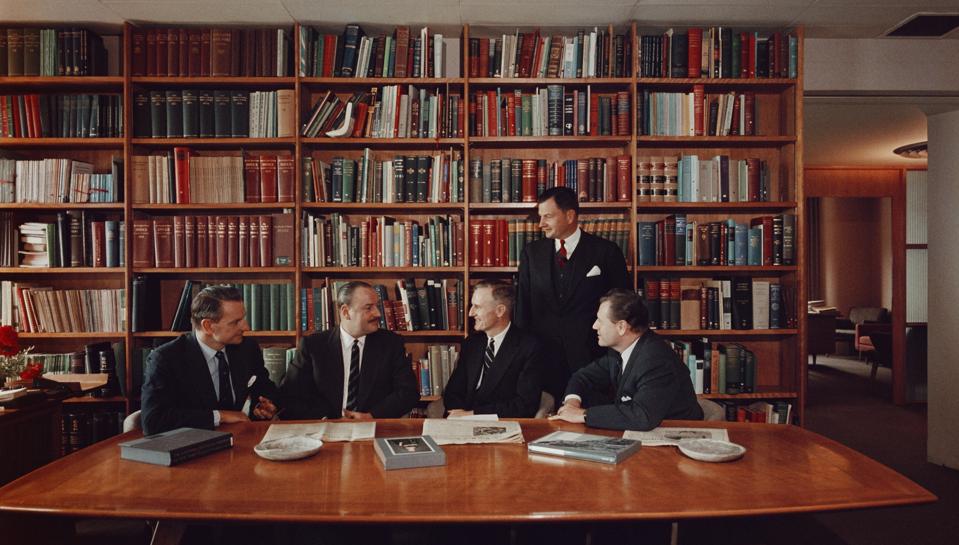
The Rockefeller brothers in their Radio City, New York office. Left to right, Laurance (1910 – 2004), Winthrop (1912 – 1973), John D. Rockefeller III (1906 – 1978), David, and Nelson (1908 – 1979). Original Artwork: A Wonderful Time – Slim Aarons (Photo by Slim Aarons/Getty Images)
Families that endure across generations, and in some cases rise into the ranks of the Forbes 400, understand that wealth is built through disciplined process, sound governance, and alignment between capital and purpose. The annual review serves as a strategic reset, ensuring financial strength while supporting a rich and intentional lifestyle.
Begin With the Right Question
The best reviews start by reframing the conversation. Instead of asking how much money was made, leading families ask whether the portfolio did what it was designed to do. Did it protect purchasing power. Did it provide liquidity and flexibility. Did it support both long term ambitions and the life the family wants to live today.
This mindset separates stewards from speculators. It is evident in families like the Michael Dell family, with capital allocation reflecting a long-term vision rather than short term market noise.
Build a Clean and Honest Scorecard
A disciplined review begins with clear data. Families focus on net results after all fees and taxes rather than headline returns. They examine volatility, drawdowns, liquidity, concentration, income generation, and alignment with spending requirements.
A strong year does not guarantee success and a weak year does not signal failure. What matters is whether outcomes matched expectations and whether risk was taken intentionally rather than accidentally. This disciplined approach is a hallmark of multi generation families such as the Walton family.
Understand What Actually Drove Results
Attribution is where sophisticated reviews diverge from casual ones. Instead of broad explanations, families break performance into its true drivers.
They evaluate whether asset allocation added value relative to policy targets. They assess whether managers delivered genuine skill or simply benefited from market tailwinds. They scrutinize implementation details such as taxes, turnover, cash drag, and structural inefficiencies. Private investment pacing is reviewed carefully, since capital committed in the wrong cycle can shape outcomes for years.
Families like the Koch family have long emphasized disciplined allocation and internal controls as drivers of durability rather than relying on any single market cycle.
Conduct a Real Risk Review
Risk analysis at the family office level goes far beyond market volatility. The real question is not what could go wrong, but what could materially impair the family’s flexibility or security.
Families examine hidden correlations across managers, liquidity mismatches between assets and obligations, operational and key person risks, legal and structural complexity, and counterparty exposure. Many run scenario analyses not to predict the future, but to ensure preparedness across a wide range of outcomes.
This focus on survivability is a defining trait of families that last for generations.
Focus on After Tax Reality
Taxes sit at the center of the year end conversation for sophisticated families. Pre-tax returns may look impressive, but after-tax outcomes determine lifestyle, optionality, and legacy.
Families review realized and unrealized gains, tax loss harvesting effectiveness, charitable strategies, asset location decisions, and changes in residency or entity structure. Over time, intelligent tax management can rival investment selection as a driver of long-term success, as demonstrated by investors such as Jeff Yass.
Review Decision Quality, Not Just Outcomes
Many experienced families maintain a record of major investment decisions along with the assumptions behind them. Revisiting these decisions at year end creates a powerful feedback loop.
This practice reduces hindsight bias and helps families improve how decisions are made rather than simply reacting to results. Over decades, a strong decision process compounds just as reliably as capital itself.
Revisit Mission, Values and Purpose
An increasingly important part of the annual review is a deliberate discussion of mission, strategy, and values. Families step back to ask whether their capital deployment reflects who they are and what they want to contribute.
This includes reviewing philanthropic activity, charitable structures, and giving effectiveness, as well as assessing whether next generation family members are being prepared to steward both financial and social capital. Families like the Frist family exemplify how mission driven capital can reinforce both impact and cohesion.
Translate Goals into an Operating Plan
Once the review is complete, families turn insight into action. Goals are converted into a practical operating plan with clear allocation ranges, liquidity thresholds, private investment pacing targets, concentration limits, tax objectives, and governance cadence.
Responsibility is assigned and success is defined in advance. Without this level of structure, even well-intentioned plans tend to drift.

WASHINGTON, DC – DECEMBER 02: Tech billionaires Susan Dell and Michael Dell speak as U.S. President Donald Trump makes an announcement about “Trump accounts” in the Roosevelt Room at the White House on December 02, 2025 in Washington, DC. Dell is contributing $6.25 billion of his own money to the program, which aims to have the government provide $1,000 in seed money for investment accounts that will be granted to children born in the next four years. (Photo by Chip Somodevilla/Getty Images)
Wealth Should Support a Great Life
The most effective year end reviews conclude with a lifestyle conversation. Capital is a tool, not the mission. Families reflect on whether spending aligned with values, whether time was invested in health and relationships, and whether wealth enhanced freedom rather than complexity.
Those who build enduring fortunes understand that the goal is not just financial longevity, but a life well lived.
In the end, the annual review is not about closing the books. It is about reinforcing a generational system that compounds across decades, supporting financial strength, family cohesion, meaningful impact, and the kind of balanced success that defines the world’s most accomplished families.
By Robert Daugherty, Contributor
© 2025 Forbes Media LLC. All Rights Reserved