
This post was originally published on this site
Key Takeaways
- President Donald Trump escalated his trade war with Canada by imposing a 50% tariff on a list of products already subject to a 50% tariff.
- The latest salvo in the trade battle doesn’t expand the scope of the trade war, limiting its direct effect on the economy.
- The U.S. has typically banned imports from adversary nations or specific products over human rights concerns.
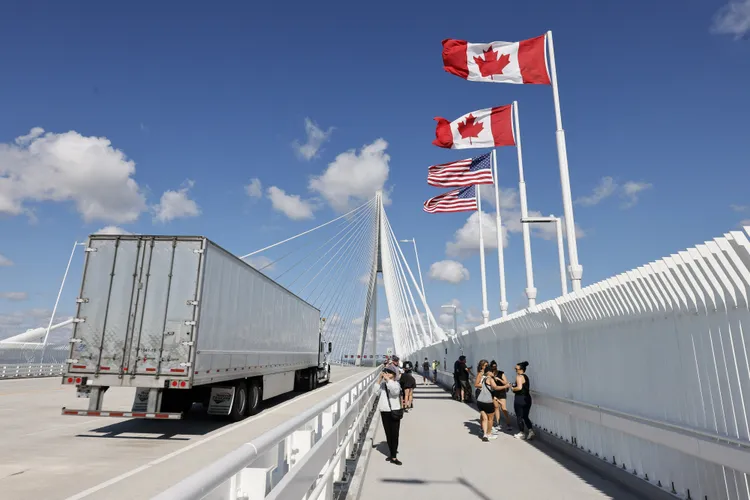
A truck crosses into the United States on the Gordie Howe International Bridge, connecting Windsor, Ontario, and Detroit, Michigan, on September 6, 2025.
Jeff Kowalsky / AFP via Getty Images
Molson beer, Can-Am motorcycles and Canadian milk may soon join Cuban cigars and Iranian carpets on the list of products Americans are forbidden to purchase at any price.
On Tuesday, President Donald Trump escalated his tit-for-tat trade war with Canada by taking the unusual step of banning a list of products outright, including many kinds of alcohol, and motorcycles with large engines, ATVs, and dairy products that were already subject to tariffs.1 The import bans are set to take effect on Sept. 29, potentially giving negotiators time to reach a deal to avert them.
The ban on Canadian products is a notable shift in Trump’s trade wars, which have mainly focused on tariffs to date. Currently, the U.S. bans imports from hostile nations (such as North Korea) or products made with forced labor, but not for more mundane trade disputes. In announcing the ban, the administration noted that some Canadian products have been banned from U.S. alcohol as part of the trade dispute.
“President Trump is taking decisive and appropriate action to respond to Canada’s additional retaliation and continued discriminatory treatment of crucial American exports,” The White House said in a statement.
The banning of Canadian products is an escalation in a trade war that economists say pushes up prices for consumers on both sides of the U.S.-Canadian border.
Trump’s action came after Canada imposed “dollar-for-dollar” tariffs against U.S. products in response to U.S. tariffs on $20 billion worth of Canadian products, announced in July.
Trump’s series of executive orders also modified the earlier tariffs, removing certain products from the 50% tariff and adding others. Off the tariff list are toilet paper, salt, cement, and fishing rods, among other household items, replaced by new tariffs on cheese, fur, motorboats, and other products.2
On balance, the bans and changes to the tariff list don’t expand the scope of tariffs or their economic impact, according to an analysis by Nathan Janzen, assistant chief economist at RBC Bank. The tariffs affect $20 billion of the $872 billion in trade between the two countries in 2025.34
“This marks an escalation, but with a 50% tariff on these products, many were already likely too expensive for U.S. importers to buy,” Janzen wrote. “Therefore, the marginal impact of the change on the Canadian economy is likely relatively small (again, notwithstanding the significant impact on specific exporters targeted).”
Still, the product bans are another escalation in a trade war that began shortly after Trump took office in 2025. Back then, Trump said the sweeping tariffs against Canada were to stop the smuggling of fentanyl, a rationale that was not mentioned in the latest wave of proclamations. Together with tariffs on numerous other countries, import taxes have stoked inflation as importers have passed their own increased costs on to consumers.
The recent tariffs and import bans also add another element of uncertainty to the economic outlook, since it’s possible they could be overturned just like Trump’s earlier efforts at imposing a tariff barrier to protect American manufacturing, which was struck down by the Supreme Court, resulting in billions in refunds for U.S. businesses that paid them.
The trade restrictions against Canada are based on the 1930 Smoot-Hawley tariff signed into law by Herbert Hoover.
“Whatever the legal pretext that is chosen by the president and his officials, the fact is that at present the U.S. tariff is whatever the president wishes it to be, which leaves the courts playing whack-a-mole, treating use of each claimed authority as sound—until it is found to be otherwise,” Alan Wm. Wolff, a senior fellow at the Peterson Institute for International Economics, wrote in a commentary.
This Investopedia article was legally licensed by AdvisorStream.