
This post was originally published on this site
Jensen Huang is out as CEO of Nvidia, putting one of the most valuable leadership premiums in corporate America to the test. Since co-founding the company in 1993, Huang helped build Nvidia into the dominant supplier of AI chips, adding roughly $3.3 trillion in market value since May 2023.
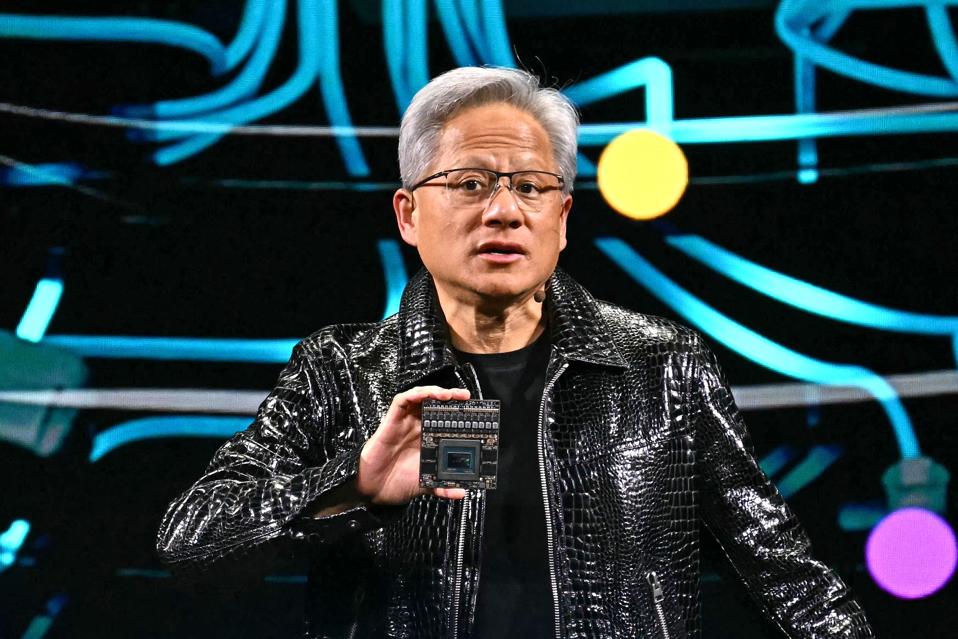
Can Nvidia Keep Its AI Lead Without Jensen Huang?
AFP via Getty Images
Now, with chief financial officer Collette Kress taking over, investors must determine how much of Nvidia’s growth, market dominance and valuation can endure without Huang at the helm. With shares down 9% in early trading Thursday, the stakes extend beyond shareholders to customers, employees and the broader AI value network.
Huang’s value added was most significant following the launch of ChatGPT. On May 24, 2023, Nvidia was worth $755 billion. The next evening, it issued revenue guidance so far above Wall Street’s expectations that the stock added roughly $184 billion in a single session, CNBC reported, which inspired me to write my 2024 book, “Brain Rush.”
By Nov. 10, 2026, the company was worth about $4.2 trillion, down from a peak near $5.5 trillion in late September. Measured from that May 2023 evening, Nvidia has created about $3.3 trillion of shareholder value.
Now Nvidia’s board has accepted Huang’s resignation as CEO. That departure could be costly. I estimate the loss of his services could put between $700 billion and $1.1 trillion of market value at risk, about $600 billion of which the stock has already lost since the investigation began.
Additional billions in revenue and cash flow could be lost in the next three years.
How Much Value Did Nvidia Create?
Huang presided over revenue that increased dramatically and soaring free cash flow. Between fiscal 2024 and fiscal 2026, revenue rose more than 3.5-fold from $60.9 billion to $215.9 billion. In the first half of fiscal 2027, the company generated revenue of $177.8 billion. The company’s fiscal year ends in January.
Annual free cash flow climbed from $26.9 billion to $96.6 billion, and Nvidia has returned about $131 billion to shareholders through buybacks and dividends since fiscal 2024 began, according to SEC filings.
How Nvidia Powered the AI Value Network
Nvidia’s spending has generated revenue throughout the value network. It became TSMC’s largest customer, accounting for about 19% of 2025 revenue, or roughly $23 billion. Its supply commitments more than doubled, from $119 billion to $279 billion, in one quarter, mostly for memory.
Those long-term supply commitments helped chip makers such as SK Hynix, Micron and Samsung increase their stock market value, with the first two crossing $1 trillion in market value in May 2026.
Nvidia has also contributed to higher revenue at other suppliers. Dell expects about $74 billion of AI server revenue this year on a $95 billion backlog, and Super Micro’s fiscal 2026 revenue reached $39.1 billion. Vertiv’s backlog for cooling and power gear doubled to $15 billion.
Hyperscalers Microsoft, Alphabet, Amazon and Meta expect roughly $730 billion in 2026 capital spending, much of it on Nvidia systems. Nvidia chips enable OpenAI, Anthropic and xAI to enjoy more than $2 trillion in private value combined.
While Nvidia did not cause all that value creation, its introduction of new, more powerful chips helped accelerate the pace. That’s because demand for chips starts with AI labs and their users. Nvidia designs chips, and companies like TSMC make them. Memory and other complementary goods go along with the building of new data centers.
Nvidia Is Also Financing the AI Boom
Nvidia is also a major financier of the AI value network. The company reported $99 billion in equity investments and $25 billion in further commitments in its July 2026 quarterly report.
These include $30 billion in OpenAI, up to $10 billion in Anthropic, an Intel stake worth about $30 billion, about $21 billion of SpaceX and xAI, and CoreWeave shares plus a $6.3 billion agreement to buy the latter’s unused capacity.
Nvidia also participates in lending money to customers. For example, the company guarantees up to $105 billion in lease obligations on an Ohio campus for OpenAI and has $36 billion of AI cloud agreements.
How Much Could Huang’s Departure Cost Nvidia?
While consensus forecasts are optimistic for the next year or so, the lost value begins to show up in fiscal 2028 and 2029. Based on contracts, analysts’ consensus forecasts indicate Nvidia revenue could total about $2 trillion from fiscal 2027 through 2029, Tikr noted.
The risk for Nvidia comes in the later years unless the company’s new CEO has Huang’s skills in product design, government relationships and dealmaking with foundation model providers, all of which drive market share.
If Nvidia were to lose market share because it lacks a leader with those skills, revenue, free cash flow and stock market capitalization would decline. For instance, a 3% to 7% shortfall on that $1.6 trillion base could lower revenue by between $25 to $55 billion and slash free cash flow by between $25 billion and $55 billion.
Moreover, a stock price discount due to Huang’s departure could reduce Nvidia’s pre-scandal market capitalization of $4.5 trillion by between 15% and 25%, subtracting between $700 billion and $1.1 trillion from Nvidia’s market capitalization. The stock’s current value already reflects more than half of that decline.
What Could Happen to Nvidia’s AI Investments?
Ecosystem financing could be harder hit if Kress remains CEO. Huang has been making new discretionary deals at a roughly $40 billion to $60 billion annual average run rate, according to CNBC.
If Kress were to cut that pace by 30% to 60%, Nvidia’s equity and credit flow to the industry would remove $35 billion to $110 billion in equity and credit from the AI value network over three years. That could be painful for neoclouds such as CoreWeave.
What Nvidia Investors Should Watch Next
With Huang out as CEO, there is nobody in place at Nvidia to lead the AI economy, which could apply brakes on company and industry growth.
Investors should watch whether the board names a technologist to replace Huang who can lead the technology roadmap, whether new equity and guarantee deals slow, and whether fiscal 2028 and 2029 forecasts hold after the Nov. 17 earnings report.
© 2026 Forbes Media LLC. All Rights Reserved
This Forbes article was legally licensed through AdvisorStream.