
This post was originally published on this site
A deeper dive into the Internet experience and what it may add to the recent 60 Minutes discussion of AI, market risk, and the lessons of history.
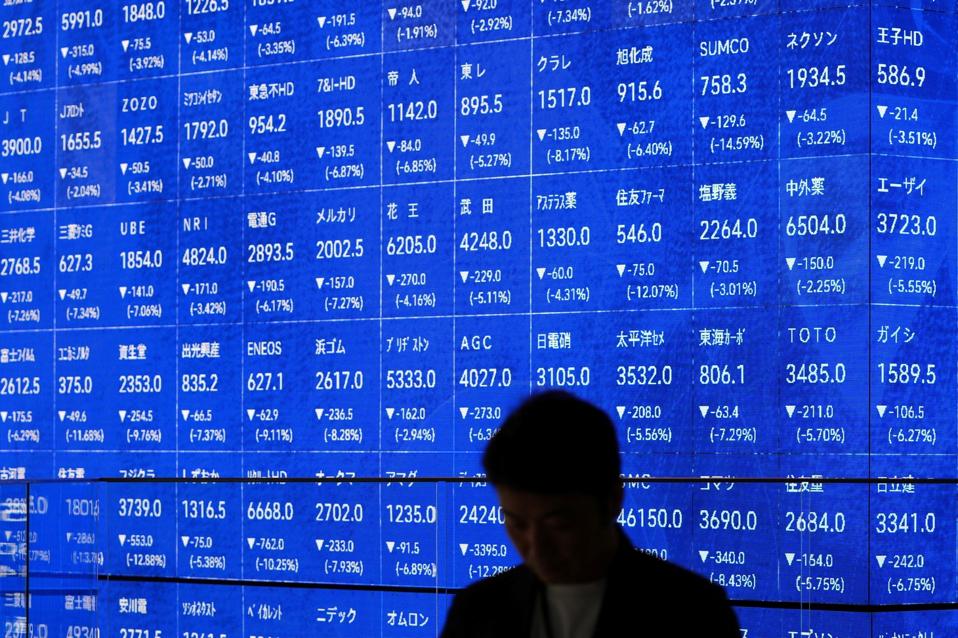
TOPSHOT – A man stands in front of an electronic board showing the Nikkei 225 index on the Tokyo Stock Exchange in Tokyo on April 7, 2025. Japan’s Nikkei share index plunged further on April 7, as US futures pointed to additional losses on Wall Street over President Donald Trump’s punishing tariffs. (Photo by Kazuhiro NOGI / AFP) (Photo by KAZUHIRO NOGI/AFP via Getty Images)
The Question Investors Are Asking
During last Sunday’s 60 Minutes interview, Andrew Ross Sorkin raised a question that is increasingly occupying investors’ minds. The issue is no longer whether a market correction will occur, but whether it will resemble the bursting of the Internet bubble or something closer to 1929.
The discussion emerged from a broader concern about the growing disconnect between financial markets and parts of the underlying economy. While stock markets continue reaching new highs, many observers question whether current valuations accurately reflect economic fundamentals. The rapid rise of AI-related companies has further fueled debate about whether investors are witnessing the early stages of a transformative technological revolution or a period of excessive optimism.
In response to concerns raised by Lesley Stahl, Sorkin suggested that AI may be helping support economic growth and justify some of the market’s enthusiasm. At the same time, he pointed to two developments that make some analysts uneasy. First, investing has become dramatically more accessible, allowing millions of retail investors to participate in markets with unprecedented ease. Second, some worry that some of the financial safeguards and market disciplines developed after previous crises may be weakening.
Together, these trends raise an important question: if a correction occurs, will losses remain largely contained within financial markets, as they did during the Internet bubble, or could they spread more broadly through the economy, as occurred after 1929?
Both are important concerns because they help determine how a future shock might spread. But there may be another lesson from history that deserves attention. Before asking how far a correction might travel, investors should also ask what might cause it in the first place.
What Actually Separated 1929 from the Internet Bubble?
The comparison between 1929 and the Internet bubble is useful because both periods featured speculation, optimism, retail participation, and a belief that the future would look fundamentally different from the present.
The key difference was financial contagion.
In 1929, losses spread through margin debt, banks, and credit markets. What began as a market decline became a broader economic crisis because the financial system itself became the transmission mechanism. Falling stock prices were only the beginning. The damage spread throughout the economy.
The Internet bubble was different. Investors lost enormous amounts of money. Many companies disappeared. Yet the damage remained largely concentrated within technology stocks and investors. The Internet survived. The financial system survived. Ultimately, society became even more dependent on the technology than enthusiasts had predicted.
This distinction helps explain why Sorkin focused on democratization and guardrails. Both influence whether losses remain contained or spread throughout the broader economy. They help answer an important question: if a correction occurs, how far will it travel?
The Lesson Most Investors Get Wrong About the Internet Bubble
When people hear the phrase “bubble burst,” they often assume investors were wrong about the underlying innovation. The Internet suggests otherwise.
Investors correctly anticipated that the Internet would transform commerce, communication, media, and business. History proved them right. Looking back, many of the grand predictions made during the late 1990s turned out to be remarkably accurate.
They were not wrong about the destination. They were wrong about the timing.
Markets priced a future Internet-enabled economy long before the supporting infrastructure, adoption patterns, and business models had fully developed. Expectations advanced faster than the real economy could absorb them.
The result was a painful correction. Not because the technology failed. Because expectations moved faster than reality. That lesson may be highly relevant today. The debate surrounding AI often assumes only two possibilities: either investors are right and AI changes everything, or investors are wrong and AI is another bubble.
The Internet suggests a third possibility. Investors can be right about the transformative power of a technology while being wrong about the speed at which the economy can absorb it.
The Expectation Loop and the Real-Economy Loop
One way to think about this challenge is through the relationship between what I call the expectation loop and the real-economy loop.
The expectation loop consists of valuations, capital flows, forecasts, narratives, and investor enthusiasm. It can move extraordinarily quickly. Expectations can change overnight.
The real-economy loop consists of the physical systems required to support technological deployment. This includes power generation, transmission infrastructure, semiconductor fabrication, data centers, permitting systems, workforce development, and the critical mineral supply chains needed to support industrial expansion. These systems are constrained by engineering realities, construction timelines, regulatory approvals, and physical capacity.
The expectation loop moves at digital speed. The real-economy loop moves at industrial speed.
During the Internet boom, the expectation loop accelerated much faster than the real economy could adapt. Investors priced the future before the underlying systems were ready to deliver it.
The question today is whether something similar is occurring with AI.
If AI is helping support economic growth, as Sorkin suggests, investors should pay close attention to the speed at which the real economy can support AI’s expansion. Building a trillion-dollar AI economy requires far more than software. It requires electricity, transmission networks, transformers, semiconductor capacity, data centers, and the critical minerals that underpin modern industrial systems. Many of these components operate on timelines measured in years rather than quarters.
This is not an argument that AI lacks transformative potential. The Internet teaches exactly the opposite lesson. Transformational technologies can change the world and still experience dramatic market corrections.
The more important question is whether markets are pricing a future that the real economy can realistically deliver on the timeline investors expect.
Institutions as the Missing Link
Importantly, these perspectives are not competing explanations. They may be different parts of the same story.
Sorkin’s concerns about guardrails focus on what happens after a shock occurs. The expectation loop and real-economy loop focus on what determines the size of that shock in the first place.
Both ultimately point toward the role of institutions.
Governments and institutions play a critical role in shaping the relationship between expectations and reality. Through industrial policy, infrastructure investment, permitting reform, workforce development, and supply-chain expansion, they can help accelerate the real-economy loop. At the same time, through financial regulation, market oversight, disclosure requirements, and other safeguards, they can influence the speed at which expectations develop and the resilience of the financial system when corrections occur.
Viewed this way, institutions perform two related functions. They help calibrate the relationship between expectations and reality, and they help determine whether corrections remain contained or spread throughout the broader economy.
The challenge is not simply predicting technological change. It is managing the relationship between technological expectations, real-world constraints, and financial stability.
Bringing the Two Perspectives Together
Sorkin’s analysis raises an important question about transmission: if a correction occurs, how far might it spread?
The Internet’s lesson suggests a complementary question: how large might the correction be in the first place?
The answer may depend on the gap between expectations and the real economy’s ability to deliver on them. The larger that gap becomes, the larger the potential adjustment when expectations and reality eventually reconnect.
Whether today’s AI boom ultimately resembles the Internet bubble or something more severe may depend on more than investor enthusiasm or financial guardrails alone. It may depend on how effectively institutions manage the relationship between expectations and reality, and how successfully they ensure that the physical systems supporting AI can keep pace with the future investors are already pricing into markets.
History suggests that investors can be right about the destination while being wrong about the timeline. The challenge for policymakers, businesses, and investors alike may be ensuring that the real economy can keep pace with the future they expect to arrive.
© 2026 Forbes Media LLC. All Rights Reserved
This Forbes article was legally licensed through AdvisorStream.