
This post was originally published on this site
Key Takeaways
- Mortgage rates surged this week, rising to a nearly three-year high as investor concerns about inflation drove up Treasury note yields.
- Rising mortgage rates are hurting homebuyer budgets and dragging down the already dismal housing market.
- Higher mortgage rates are one effect of rising yields on 10-year Treasurys, which Fed Chair Kevin Warsh called “the most important financial asset in the world.”

Kevin Carter / Getty Images
Mortgage rates posted their biggest weekly jump in four years as yields on 10-year Treasurys climbed to highs not seen in decades.
The average rate offered for a 30-year fixed mortgage jumped to 7.28% this week, up from 7.02% the week before, mortgage giant Freddie Mac said Thursday.1 That was the highest since November 2023 and the largest one-week increase since October 2022.
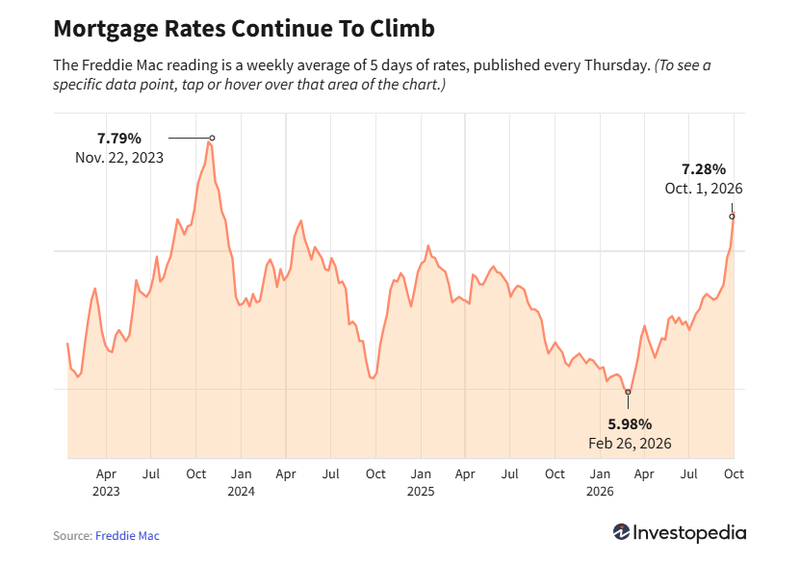
Rising rates have added hundreds of dollars a month to mortgage costs, putting homeownership out of reach for many first-time buyers and battering the already stagnant housing market.
Higher mortgage rates are one example of how rising interest rates, which have climbed amid the Iran war and other price pressures, are straining household budgets and the broader economy.
What This Means for You
Rising interest rates put pressure on most parts of the economy and are especially acute for housing, where soaring mortgage rates drive buyers out of the market.
Mortgage rates are closely tied to yields on 10-year Treasurys, which rose to a nearly quarter-century high on Thursday. The surging yields reflect investor anxiety about inflation, the Iran war, government debt in the U.S. and other countries, heavy spending by AI companies to build data centers, and other concerns.
Last month, Federal Reserve Chair Kevin Warsh called 10-year Treasurys “the most important financial asset in the world,” and the jump in mortgage rates shows why.2 Because 10-year Treasurys are considered nearly risk-free debt, they are a benchmark for mortgages and many other kinds of loans. On a car loan, for example, lenders start with Treasury yields as a baseline and then charge added interest to compensate for the possibility the loan won’t be repaid.3
Homebuyers feel rising rates most directly.
Mortgage rates have risen half a percentage point since the summer, cutting a typical house hunter’s buying power by $19,000, according to Mark Fleming, chief economist at title insurer First American Financial.
“Incomes and house prices usually change gradually,’ Fleming wrote in a blog post this week. “Mortgage rates can rewrite the affordability equation almost overnight . . . half of a percentage point is anything but small.”
Article Sources
Investopedia requires writers to use primary sources to support their work. These include white papers, government data, original reporting, and interviews with industry experts. We also reference original research from other reputable publishers where appropriate. You can learn more about the standards we follow in producing accurate, unbiased content in our editorial policy.
- Freddie Mac. “Mortgage Rates.”
- Federal Reserve. “Transcript of Chairman Warsh’s Press Conference
September 16, 2026.” - Stanford. “A Stanford Economist Explains the Bond Market.”
This Investopedia article was legally licensed by AdvisorStream.