
This post was originally published on this site
Increasingly over the years, investors have asked me about investments outside of the traditional publicly traded portfolios of stocks and bonds, a category broadly known as alternative investments. Hedge funds, venture capital, cryptocurrency, private markets, structured investments, pooled real estate investments, and more used to be known as only available to ultra-high net worth individuals and institutions.

Diversifying by putting eggs in different baskets. Those can include alternative investments if they are in line with the investor’s goals.
Getty
Now, more investors have access to this wide range of investment vehicles. With increased access, the question has shifted from “Can I?” to “Should I?” This is how to evaluate whether alternatives fit with your financial goals.
Focus on Financial Goals First
Before you select any investment for yourself, you should have a clear vision of your financial goals. Examples of financial goals include:
- Increasing current income to reduce need for work.
- Retirement on a specific income by a certain age.
- Reducing risk exposure in a concentrated position.
- Saving money for a major purchase by a certain date.
Most of these basic objectives can be achieved using a simple publicly traded portfolio of stocks and bonds. Special considerations for liquidity needs and risk profiles should be given for alternative investments. Alternatives are meant to be an addition to your overall investment strategy, not the entire thing.
The Needs Alternatives Could Address
Most commonly, I see investors using alternatives for a few purposes: enhancing income opportunities, reducing risk, and increasing returns.
Investors Who Are Income-Focused
The fixed income market has been on a wild ride for the last several years, with 2022 being the worst-ever year in fixed income. Income-focused alternatives can be used to smooth out the experience of investors in public markets because these assets are held in private markets, where valuations tend to change less frequently.
From Q1 of 2016 to Q1 of 2026, private credit manager returns ranged from 4.8-12.2%, while bond managers ranged from .1-2%. Price swings can be more limited when it’s impossible for investors to all rush and liquidate at the same time.
Investors Seeking to Reduce Their Risk
Anything new an investor adds to their portfolio with a correlation of less than one reduces portfolio risk and increases diversification. Hedge funds in particular are often designed to perform exceptionally well when specific asset classes are trending downward.
Investors can also use alternatives like pooled options strategies to protect against losses in concentrated securities as well.
Investors with Long Time Horizons
If you won’t be needing your principal investment back for a long time, you can potentially benefit from enhanced returns available from specific alternative investments. The top performers in venture capital, private equity, private credit, and hedge funds have all had better enhanced performance than the public equity and fixed income markets in the last 10 years.
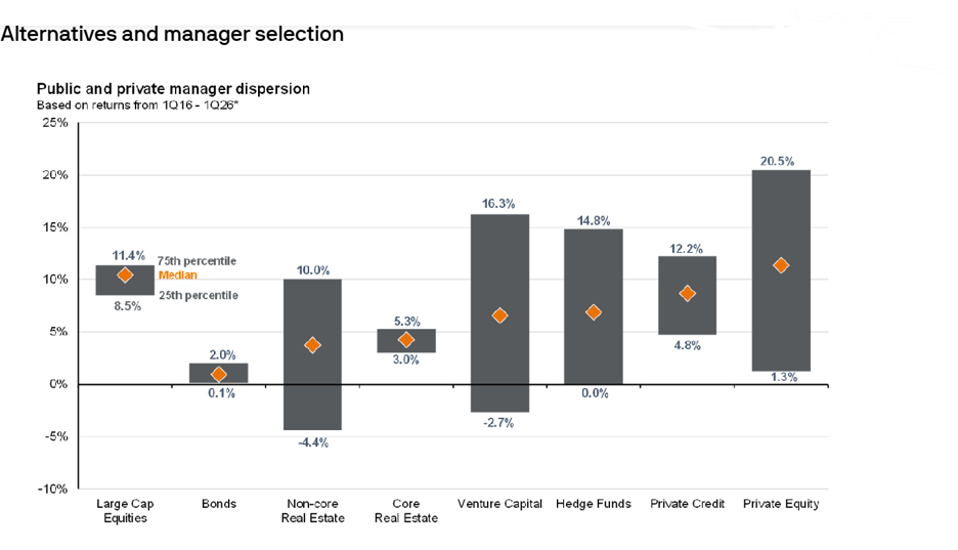
All categories are global. Large Cap Equities and Bonds are based on the Morningstar Global Large Stock Blend and Global Bond (not hedged) categories, respectively. Core Real Estate is based on the MSCI Global Property Fund Index. Private Credit, Non-core Real Estate, Private Equity and Venture Capital are based on indices from the MSCI Private Capital Universe. Hedge Funds are based on the PivotalPath index. Manager dispersion is based on annual returns over the 10-year period indicated for: Large Cap Equities, Bonds and Hedge Funds. *Manager dispersion is based on annual returns over the 10-year period ending 4Q25 for Core Real Estate. Manager dispersion is based on the 10-year internal rate of return (IRR) ending 4Q25 for: Private Credit, Non-core Real Estate, Private Equity and Venture Capital. Past performance is no guarantee of future results. This slide comes from our Guide to Alternatives. Guide to the Markets – U.S. Data are as of August 31, 2026.
Burgiss, Morningstar, MSCI, PivotalPath, J.P. Morgan Asset Management.
When Alternatives May Not Be Appropriate
Even though alternatives are more widely available than ever, they just are not going to make sense for certain investors. I have a client who has limited liquid nonretirement assets but placed most of his liquid money in a non-public real estate investment trust. This has presented some problems for him over the years, including the fact that when his objectives changed years later, he was not able to liquidate his share at its full value.
Alternatives are not appropriate when you have or may have liquidity needs during the life of the investment, which can vary widely. They’re also not appropriate when you don’t have sufficient exposure to other investments to achieve diversification. This was a big reason why alternatives were once only available to high-net-worth investors.
Alternatives also tend to be complicated, so while you should always review the prospectus in depth, if there is any aspect you are not understanding and your advisor cannot adequately explain to you, you should not be investing in alternatives.
Alternatives Are Not the End-All Be-All
Ultimately, most investors will be able to hit their financial goals by simply investing in a publicly traded portfolio of stocks and bonds in line with their risk tolerance. For retail investors, the potential benefits of alternative investments do not outweigh the risks and lack of liquidity.
Alternative investments can play a valuable role for some investors, but access alone is not a reason to invest. The right strategy starts with your goals, liquidity needs, risk tolerance, and overall financial picture. When used thoughtfully and in moderation, alternatives can complement a portfolio, but they should support your plan, not define it.
© 2026 Forbes Media LLC. All Rights Reserved
This Forbes article was legally licensed through AdvisorStream.